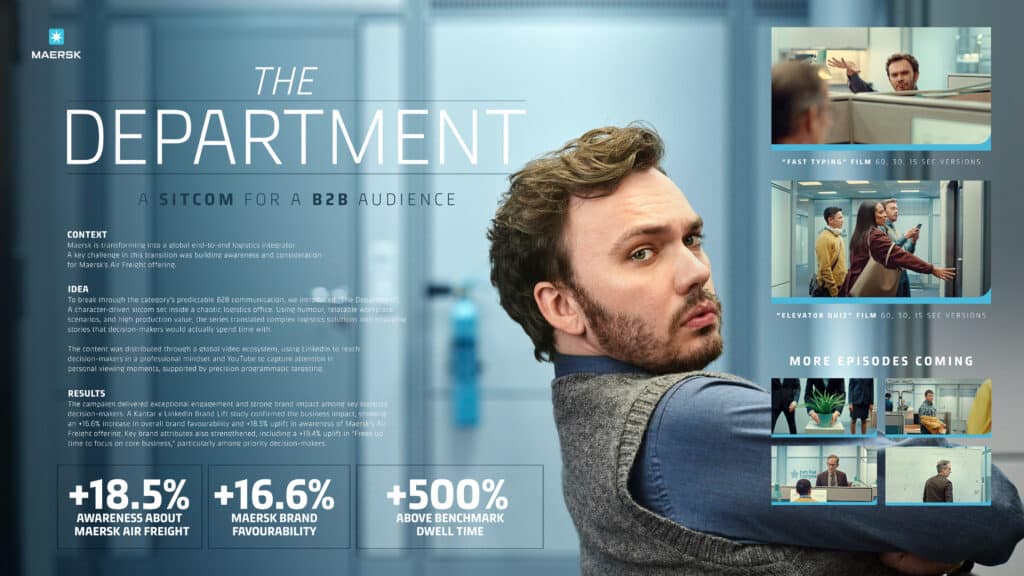



Maersk, one of Denmark’s most iconic companies, is undergoing a major transformation from a traditional ocean carrier to a global end-to-end logistics integrator. A key part of this shift is building awareness of Maersk’s Air Freight offering – an area where the brand historically had low visibility.
However, our analysis revealed a fundamental challenge: the logistics industry communicates in a way that is almost indistinguishable. The category is dominated by the same visuals and messages – containers, trucks and corporate interviews – creating a sea of identical B2B communication.
The result is simple: decision-makers scroll past.
Stagnating engagement across the sector showed that traditional B2B tactics were no longer effective. To build awareness for Air Freight, Maersk needed to break the category.
Our strategy therefore focused on disrupting category conventions, strengthening perception of Maersk as a logistics partner and increasing consideration among logistics decision-makers to support long-term commercial growth.
The strategy was built on a simple insight: Logistics decision-makers are people first and professionals second. In a ruthless attention economy, purely rational messaging does not earn attention. If we wanted to explain complex logistics solutions, we first had to earn the audience’s time.
Instead of behaving like a logistics advertiser, Maersk chose to behave like an entertainment brand.
The result was “The Department”, a character-driven comedy universe set inside a fictional logistics department. Through humour, relatable office scenarios and high production value, the series captures the everyday chaos logistics professionals recognise, while naturally demonstrating how Maersk solves real operational challenges – including the speed and reliability of Air Freight.
The content was distributed through a global video ecosystem designed to reach decision-makers in both professional and personal contexts. LinkedIn served as the B2B anchor, disrupting typically dry feeds with episodic storytelling, while YouTube extended the universe into more relaxed viewing environments. Programmatic video and display ensured precise targeting of relevant logistics stakeholders, while local adaptations on platforms such as iQiyi, MangoTV and WeChat enabled the strategy to scale in China.
The bold shift from traditional B2B communication to entertainment-driven storytelling delivered exceptional results.
On LinkedIn, the campaign achieved an average dwell time of 18.41 seconds, more than 500% above platform benchmarks and among the strongest performances on LinkedIn in all of 2025. The videos delivered a 67% view rate, more than double the B2B average, demonstrating a remarkable ability to capture attention among logistics decision-makers.
A Kantar x LinkedIn brand lift study confirmed that this attention thankfully translated into meaningful brand impact.
Overall brand favourability increased by 8.8%
Awareness of Maersk’s Air Freight offering rose by 5.2%
Agreement with the attribute “frees up time to focus on core business” increased by 7.5%.
By breaking category conventions and earning real attention, Maersk successfully repositioned itself in the minds of logistics buyers and proved that even in B2B, entertainment can drive business transformation.