


Maersk.com serves hundreds of thousands of customers globally across logistics, shipping, and supply chain management. Scale creates complexity: customers struggled to find information, generating millions of support cases annually, most resolvable through better self-service. The strongest intent signal was already there — search. But the old site search was keyword-based, returned generic links, and had a click-through rate of just 14%. Best-performing B2B site search achieves 20–30%. Maersk’s was roughly half that floor. No direct answers, no intent understanding, no feedback loops. Customers who couldn’t find answers submitted cases instead.
Ask Maersk was conceived as an intelligent nervous system for Maersk’s digital customer experience — an AI-driven layer connecting data, content, and user intent to create contextual interactions that improve with every exchange. Not an upgraded search tool, not another siloed experiment. Over three to five years, it will evolve into an autonomous service layer: anticipating needs, resolving tasks previously requiring human intervention, and guiding users from intent to outcome. A customer checking dangerous goods regulations today will, within two years, classify, book, and receive compliance confirmation in a single conversational flow — replacing a process spanning multiple systems.
The shift was from keywords to intent, from links to answers, and from isolated search to AI in real workflows. We designed for trust from day one: source transparency, disclaimers, and integrated feedback, because in B2B logistics, inaccurate information disrupts shipments, compliance, and commercial processes. Mapping queries to the highest-volume support case categories confirmed 80% overlap, validating the business case before significant investment was committed.
The strategic logic is anchored in one principle: every interaction should resolve faster, convert better, or teach us something we didn’t know. First, Ask Maersk is an automated resolution engine — every query resolved is a case never created. Second, it acts as a commercial agent, routing buying intent into transactional flows without human intervention. Third, it becomes a real-time sensor for customer needs, feeding insight into content, product, and editorial decisions across 100,000+ pages. The architecture extends beyond Maersk.com as platform intelligence — reaching off-domain AI systems, internal users, and commercial workflows — so every improvement compounds across channels.
To our knowledge, no logistics company has deployed generative AI at this scale and integration into live commercial workflows. Ask Maersk is not an experiment. It is core infrastructure for how Maersk serves customers digitally — and how customers choose to do business with Maersk.
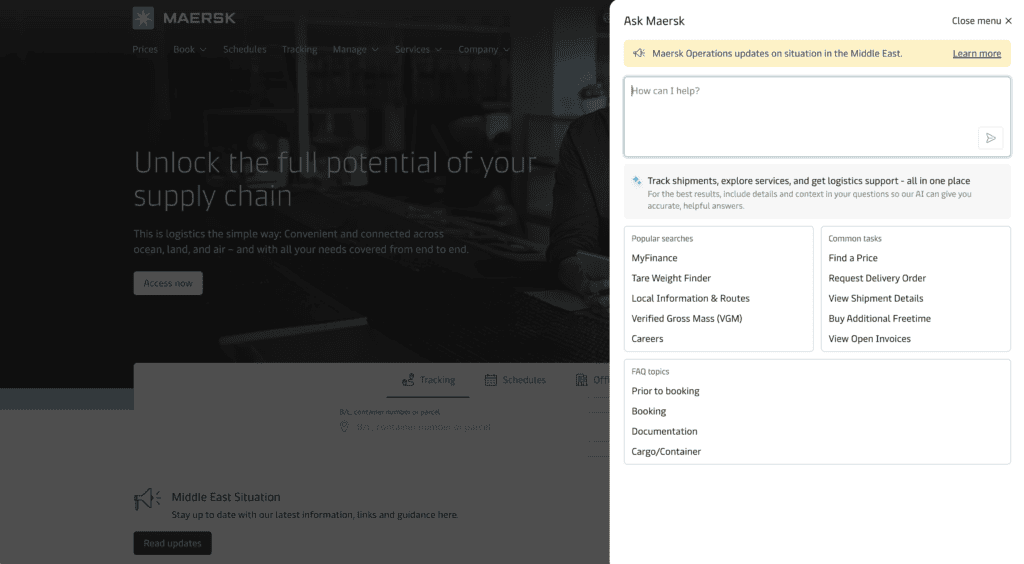
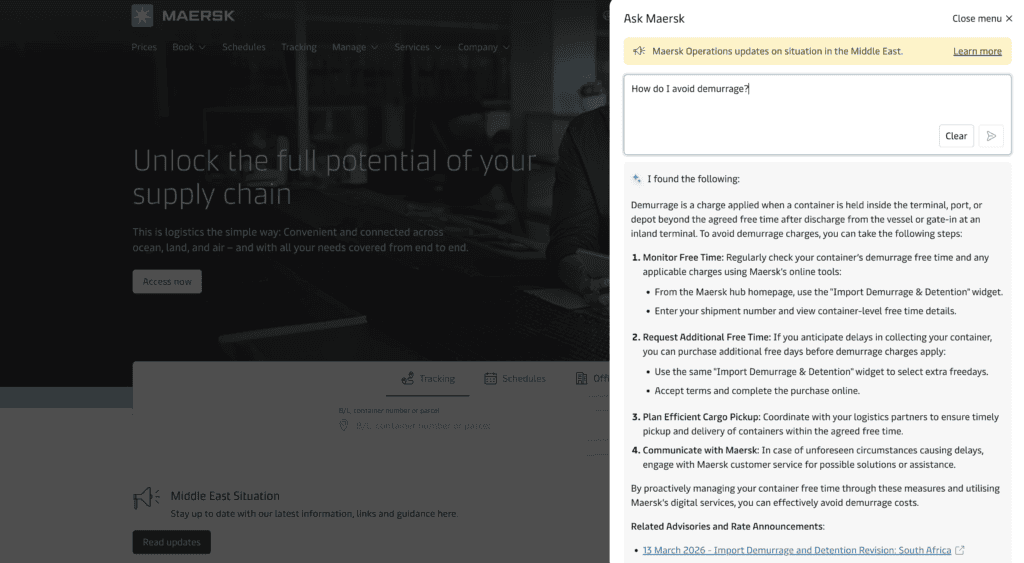
Ask Maersk replaces traditional site search with a generative AI experience purpose-built for B2B logistics, where wrong answers carry real operational and regulatory risk, and users need to act, not just read.
We designed Ask Maersk as a single-pass system, where each query is resolved in one go by combining retrieval, reasoning, and action. The model determines whether to pull from the knowledge base, call an API, or query MCP-connected services, then returns a final answer without multi-step agent loops. This was a deliberate choice. Rather than building a complex iterative agent, we prioritised speed, consistency, and control — resulting in a system that responds quickly, behaves predictably, and is easier to govern in production.
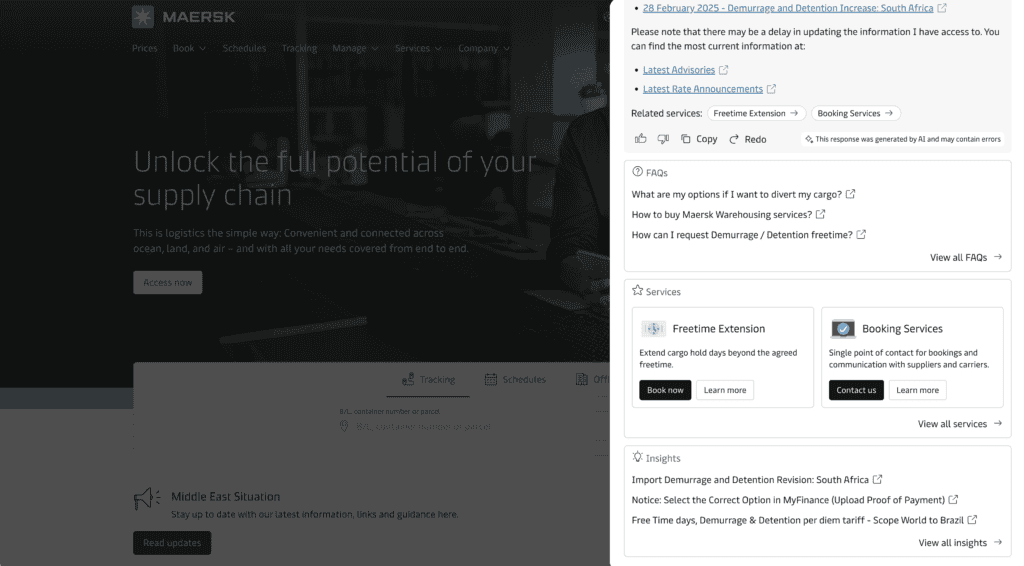
At its core, the architecture combines a curated, continuously updated knowledge base with a hybrid response model: AI-generated answers blended with structured content, service cards, and proactive product recommendations. This ensures accuracy in regulated logistics contexts such as dangerous cargo, embargoes, and sustainability, where pure generative AI alone is insufficient. Every response includes source attribution and disclaimers, grounding outputs in verified content. Close collaboration with legal and compliance ensured the system reflects organisational standards and values — a significant undertaking that differentiates this from AI deployments where governance is treated as an afterthought. Automated ingestion keeps knowledge current, while APIs and MCP servers enable real-time, operational responses within a simple, fast, and reliable system.
Its API layer makes Ask Maersk a two-way platform. The same intelligence powers the official Maersk GPT agent on OpenAI and is accessible to colleagues through Maersk’s internal AI platform. It is also embedded into live sales journeys, identifying commercial intent and serving contextual recommendations in real time. Live integrations already allow customers to track shipments or search vacancies within the conversation — no context switch required.
The roadmap extends to invoicing, routes and schedules, booking, and case management, progressively turning Ask Maersk into the unified front door to Maersk’s full digital capabilities. Multilingual coverage is actively underway. A phased rollout — logged-in users in Q2 2025, global visitors in Q3 2025 — allowed the team to validate and scale with real results. An integrated feedback loop drives continuous improvement: negative feedback triggers knowledge base reviews, query patterns inform editorial prioritisation, and customer sessions surface qualitative context. The positive feedback rate reached 58% within months from zero. It is a capability being built, owned, and continuously improved inside the company.
Ask Maersk was built to reduce friction. What the results reveal is more significant: customers have come to depend on it. Independent research found that 79% of respondents said an improved Ask Maersk would significantly or very significantly influence their logistics decisions. That is not an engagement metric. It is evidence that Ask Maersk has shifted from a useful feature to a trusted part of how customers do business with Maersk.
The growth trajectory tells its own story. Daily unique users averaged 650 before launch. The October 2025 global rollout triggered an immediate step-change to a sustained 1,000 to 1,500. March 2026 has established a new normal of 1,500 to 2,500, with the curve still climbing. A 3x increase from the pre-AI baseline, with a 9x target of 6,000 daily unique users as sales journey embedding, multilingual rollout, and case handling go live. The quality of engagement has shifted just as sharply. The old site search had a 14% click-through rate; industry benchmarks for B2B sit at 15–20%. Ask Maersk now delivers 41.6% — more than double the top of the benchmark range.
The efficiency case is equally robust. Matching queries against millions of annual support cases confirmed that 77% of the most common case intents are directly covered. Early operational data shows a measurable decline in contact volume since launch. Cost avoidance has been validated internally at a scale that justifies the investment multiple times over.
The commercial results have exceeded expectations. The product recommendation click rate reached 3.1%, outperforming the global benchmark of 2%. AI-recommended services generated a statistically significant 21.6% uplift in engagement compared to non-AI equivalents. Around 1,500 users per month now enter commercial journeys through Ask Maersk, a conversion channel that did not exist eighteen months ago.
The reach extends beyond Maersk.com. The official Maersk GPT agent on OpenAI is now powered by Ask Maersk, bringing Maersk’s intelligence to users who may never visit the website. Internally, colleagues access the same capability through Maersk’s AI platform. This is not product extension. It is the strategy executing. Ask Maersk is becoming the intelligence infrastructure through which Maersk serves its customers digitally: connecting intent to action, content to outcome, and customer need to organisational response. The results validate the direction. The scale of what comes next is the point.